
How to Search Suffolk County Court Records
Pick the system that matches your court. For Supreme Court and County Court civil cases, use WebCivil Supreme. For local District Court civil cases in the five western towns, use WebCivil Local. Pending criminal court dates show in WebCriminal. E-filed case documents live in NYSCEF. Estate and will files are in WebSurrogate. Land records, judgments, liens, and court minutes held by the elected clerk are in the Suffolk County Clerk Search Records portal. No one Suffolk site covers every record, so you may use two or three tools for a full picture.
Before you start, gather what you know. A party name, an index or case number, and the year of filing all speed up a search. The more you bring, the fewer results you sift through.
- Identify the court. Divorce, high-dollar civil, foreclosure, and guardianship go to Suffolk Supreme Court. Felony trials go to County Court. Local civil, small claims, and misdemeanors in the western towns go to District Court. Estates go to Surrogate's Court.
- For civil cases, open WebCivil Supreme or WebCivil Local and search by index number, party, attorney, or judge.
- For a pending criminal date, open WebCriminal and search the defendant name. It shows future dates only, not warrants or closed cases.
- For e-filed documents, use NYSCEF case search as a guest.
- For estate files, open WebSurrogate, or request a paid file search by mail from the Surrogate's Court.
WebCivil Supreme takes a few basic fields. Knowing them ahead of time helps.
| Field Label | Type | Required | Notes / Format |
|---|---|---|---|
| Index Number | Text | No | Search by an exact index number. |
| Name | Text | No | Party name search. |
| Attorney Name | Text | No | Search by attorney or firm. |
| Court(s) | Multi-select | No | Narrow to Suffolk County Court or Suffolk Supreme Court. |
| Year of Filing | Dropdown | No | 1983 through the current year. |
| Case Status | Radio | No | Open (active, restored) or All. |
| Create output as | Radio | No | HTML or PDF. |
The Suffolk County Judicial System
New York names its courts in an unusual way. The Supreme Court is the main trial court, not the top court. In Suffolk, Supreme Court hears major civil matters, divorce, separation, annulment, foreclosure, and guardianship. The Court of Appeals in Albany is the highest state court. Appeals from Suffolk trial courts go to the Appellate Division, Second Department. Suffolk sits in the 10th Judicial District with Nassau County.
Below Supreme Court, the work splits by case type and by town. County Court runs felony trials and limited civil cases up to $25,000. District Court is the local civil and criminal court, but only in the five western towns. The eastern towns still use town and village justice courts. Family Court hears child and family cases. Surrogate's Court handles estates and wills.
Case flow: Town/Village or District Court › County Court › Supreme Court › Appellate Division, Second Department › Court of Appeals
The official Suffolk Supreme Court page lists locations, hours, and the kinds of cases the court hears. The screenshot below shows that overview.
Source: Suffolk County Supreme Court overview.
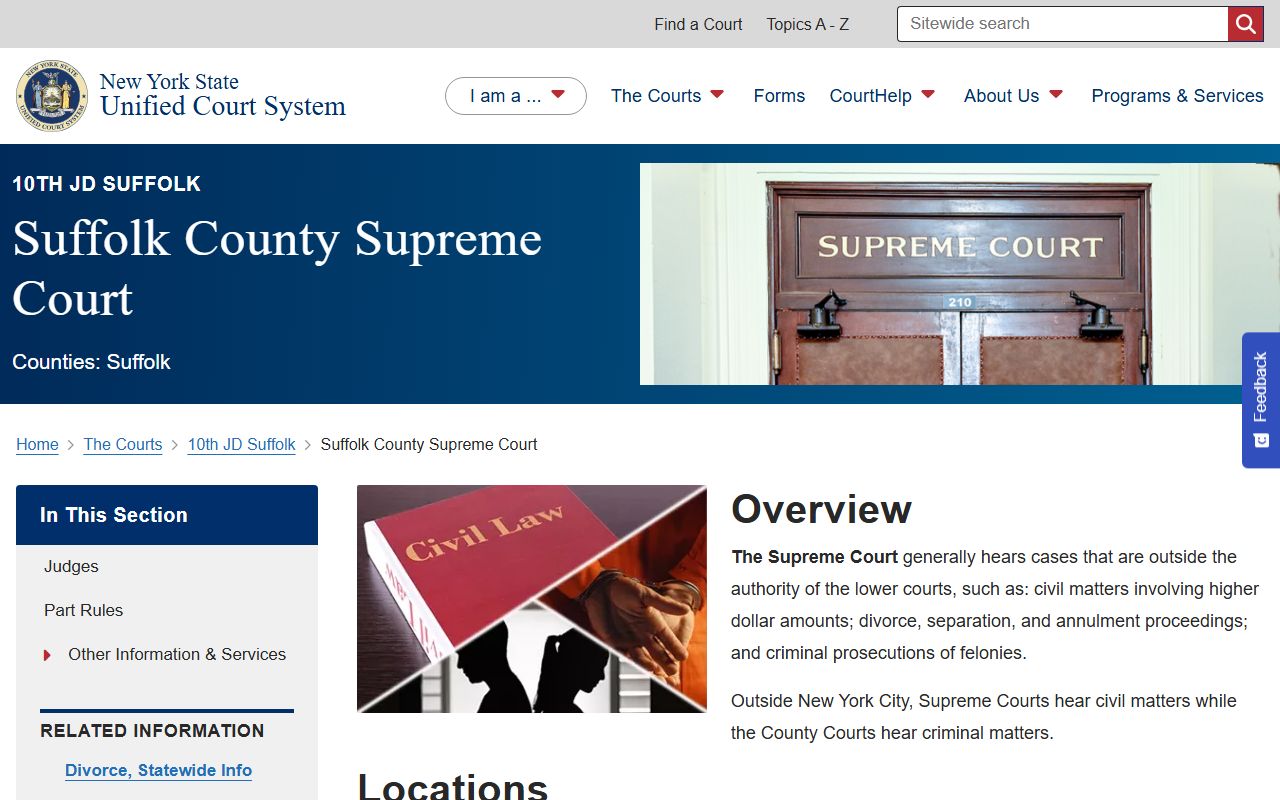
That page is a good starting point when you are not sure whether your civil case sits in Supreme Court or a lower court.
| Court | Jurisdiction | Case Types |
|---|---|---|
| Supreme Court | General original; civil and matrimonial | Divorce, foreclosure, Article 78, guardianship, high-dollar civil |
| County Court | Felony and limited civil to $25,000 | Felony trials, indictments, ERPO applications |
| District Court | Western towns only; local civil and criminal | Misdemeanors, civil to $15,000, small claims, landlord-tenant |
| Family Court | Children and families | Custody, support, abuse/neglect, juvenile, adoption |
| Surrogate's Court | Estates and wills | Probate, administration, guardianship, accounting |
Suffolk County Courthouses
Suffolk does not run all of this from one building. Court work clusters in two places. Riverhead is the county seat and holds the County Clerk, County Court, Surrogate's Court, the jury office, and Supreme Court civil functions along Center Drive. Central Islip is the other hub, with the District Court criminal term, Supreme Court matrimonial and guardianship parts, Family Court, and the federal courthouse.
The Arthur M. Cromarty Criminal Court Complex at 210 Center Drive in Riverhead is the main criminal court building. The Hon. Alan D. Oshrin Supreme Court Building sits nearby at 1 Court Street. Below are the core Riverhead offices and the main District Court building.
Suffolk County Court
Arthur M. Cromarty Criminal Court Complex
210 Center Drive
Riverhead, NY 11901
(631) 852-2120
Suffolk County Supreme Court
Hon. Alan D. Oshrin Building
1 Court Street
Riverhead, NY 11901
(631) 740-3850
District Court Building
John P. Cohalan Jr. Court Complex
400 Carleton Avenue
Central Islip, NY 11722
(631) 208-5800
Photo ID is required to enter the Riverhead court and records buildings. Most offices open Monday through Friday, 9:00 a.m. to 5:00 p.m.
Types of Court Records Available in Suffolk County
Suffolk County court records span many case types, and each lives in its own system. Civil records from Supreme and County Court include the summons, complaint, motions, orders, judgments, and minute entries. Criminal records from County Court can include the indictment, arraignment entries, bail terms, plea, sentence, and certificate of disposition. District Court keeps local civil, small claims, landlord-tenant, and misdemeanor files. The County Clerk records judgments, liens, deeds, mortgages, and UCC filings on the side.
Knowing which court produces a record points you to the right tool. Use the list below as a quick map.
- Civil records - Supreme Court and County Court filings; search WebCivil Supreme.
- Criminal records - County and District Court; pending dates in WebCriminal.
- Family and divorce records - Family Court cases and Supreme Court divorce decrees.
- Probate records - estate and will files in Surrogate's Court via WebSurrogate.
- Traffic records - tickets through the county traffic agency or District Court.
The state court site keeps a District Court overview that explains what the western-town court handles. The page is shown here.
Source: Suffolk County District Court overview.
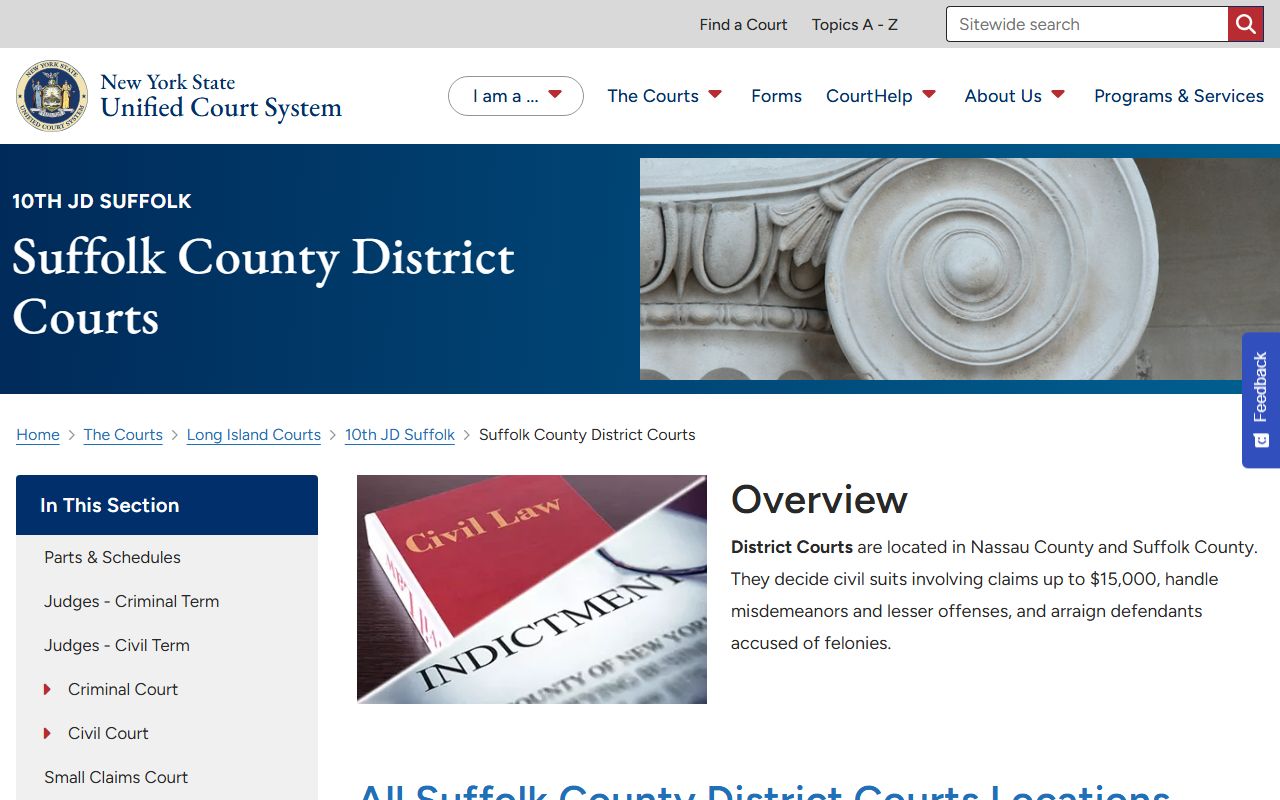
If your case is a local civil suit or a misdemeanor in Babylon, Brookhaven, Huntington, Islip, or Smithtown, this is the court that holds it.
What Suffolk County Court Records Show
A Suffolk County court record gives the basic facts of a case. You see who filed it, when, in which court, and how it ended. Civil files use an index number. Local District files use a case type, number, year, and court code. Criminal files show charges, plea, and sentence. The table breaks down the common fields and what each one tells you.
| Field | What It Shows |
|---|---|
| Index / Case Number | The filing number used to pull the court file. |
| Court | Supreme, County, District, Family, or Surrogate's. |
| Parties | Plaintiff or petitioner and defendant or respondent. |
| Filing Date | When the case was started. |
| Case Type | Foreclosure, matrimonial, contract, criminal, and more. |
| Disposition | How the case ended, such as judgment or dismissal. |
| Minutes | Dated entries of court actions and orders. |
Public Access Laws for Suffolk County Court Records
New York splits records access into two paths. Agency records, like Sheriff incarceration files, fall under the Freedom of Information Law (FOIL). Court case files follow Judiciary Law, court rules, and case-type statutes instead. That is why a jail record goes through a FOIL request while a divorce decree goes through the County Clerk under Domestic Relations Law. Knowing which path applies saves a wasted request.
A few key statutes shape what you can see and what it costs.
Key Statutes:
New York Public Officers Law Article 6 (FOIL) - sets the policy that agency records are open unless an exemption applies.
Judiciary Law § 255 - requires court clerks to search files on request and certify the result.
Criminal Procedure Law § 160.50 - seals records after a case ends in favor of the accused.
Domestic Relations Law § 235 - keeps matrimonial files confidential and limits who gets copies.
Records That Are Restricted or Confidential
Not every court file is open. New York seals or restricts several kinds of records to protect privacy. Matrimonial and divorce files are limited to the parties, their attorneys of record, or someone with a court order. Adoption records are sealed. Many Family Court files, including juvenile delinquency and abuse cases, are closed to the public. Criminal cases that end in favor of the accused are sealed under Criminal Procedure Law. Surrogate's Court keeps certain personal information out of public view under court rule 22 NYCRR 207.64.
New York leans on sealing more than expungement. When a case ends in dismissal or acquittal, sealing often happens by law. For old convictions, an eligible person can petition the sentencing court to seal under Criminal Procedure Law § 160.59, with notice to the district attorney. The court reviews the request and may hold a hearing.
Specialty Courts in Suffolk County
Suffolk runs several treatment-based courts that work apart from the standard criminal track. These programs aim to fix the root problem rather than just punish.
The Judicial Diversion Program, a felony drug court, monitors people whose crimes tie to substance use. Participants follow treatment, life-skills, and education plans, and face sanctions for violations. Suffolk Veterans Court diverts eligible veterans into treatment for issues like substance use, mental illness, homelessness, and unemployment, and a finished program can reduce the charge. The District Court in Central Islip also lists Mental Health Court, Domestic Violence Court, and Human Trafficking Court among its programs. Family Court runs a Family Treatment Court for child-welfare cases tied to substance use.
Suffolk County Sheriff and Jail
The Suffolk County Sheriff's Office, led by Sheriff Errol D. Toulon, Jr., runs two jails. Riverhead Correctional Facility at 100 Center Drive South has a capacity of 840. Yaphank Correctional Facility at 200 Glover Drive has a capacity of 976. Both hold men and women at minimum, medium, and maximum security, with medical and rehabilitation units. Yaphank also runs the Sheriff's Addiction Treatment Program, a Veteran's Pod, and a 55+ Pod.
The Sheriff's homepage lists the office address, the current sheriff, and recent press items.
Source: Suffolk County Sheriff's Office.
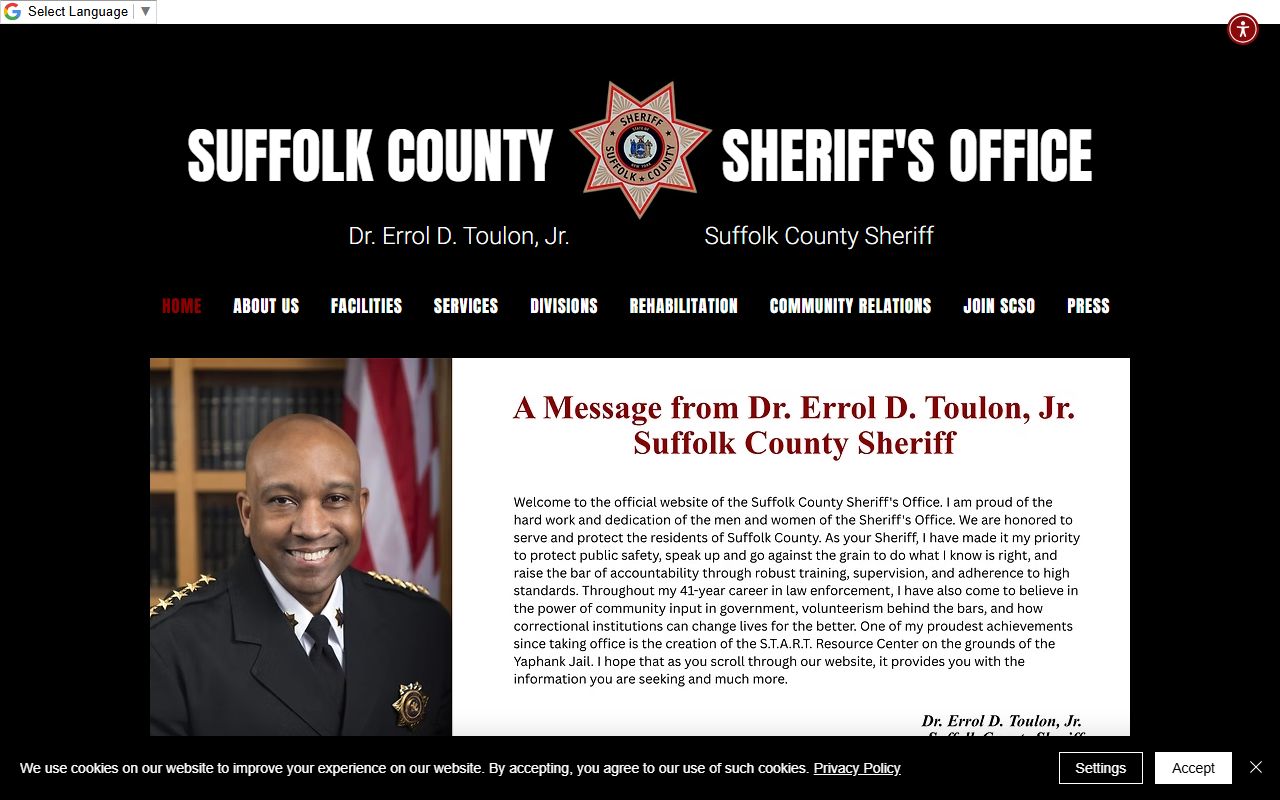
For custody details, see the full Suffolk County inmate records page, and check warrant records if a court date was missed.
Marriage, Divorce, and Surrogate's Court Records
Divorce is handled only by the Supreme Court in New York. The signed divorce decree is then filed with the Suffolk County Clerk, who limits certified copies to the parties, attorneys of record, or a person with a court order. Marriage licenses come from the town clerk that issued them, and divorce certificates since 1963 are held by the state Department of Health. Estates and wills go to Surrogate's Court, searchable through WebSurrogate. See the marriage and divorce records and Surrogate's Court pages for the full process.
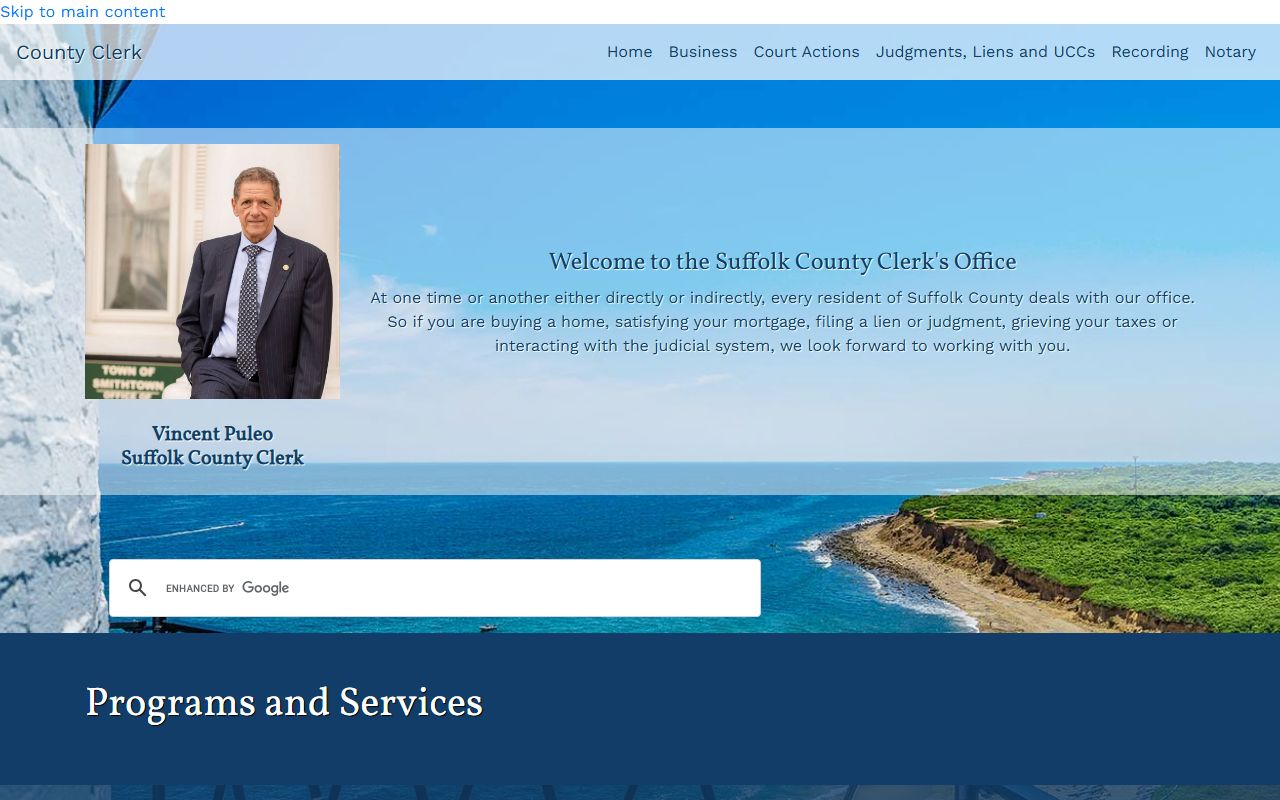
The County Clerk's programs page outlines online records, copy requests, and the Homeowner Watch List.
Source: Suffolk County Clerk programs and services.
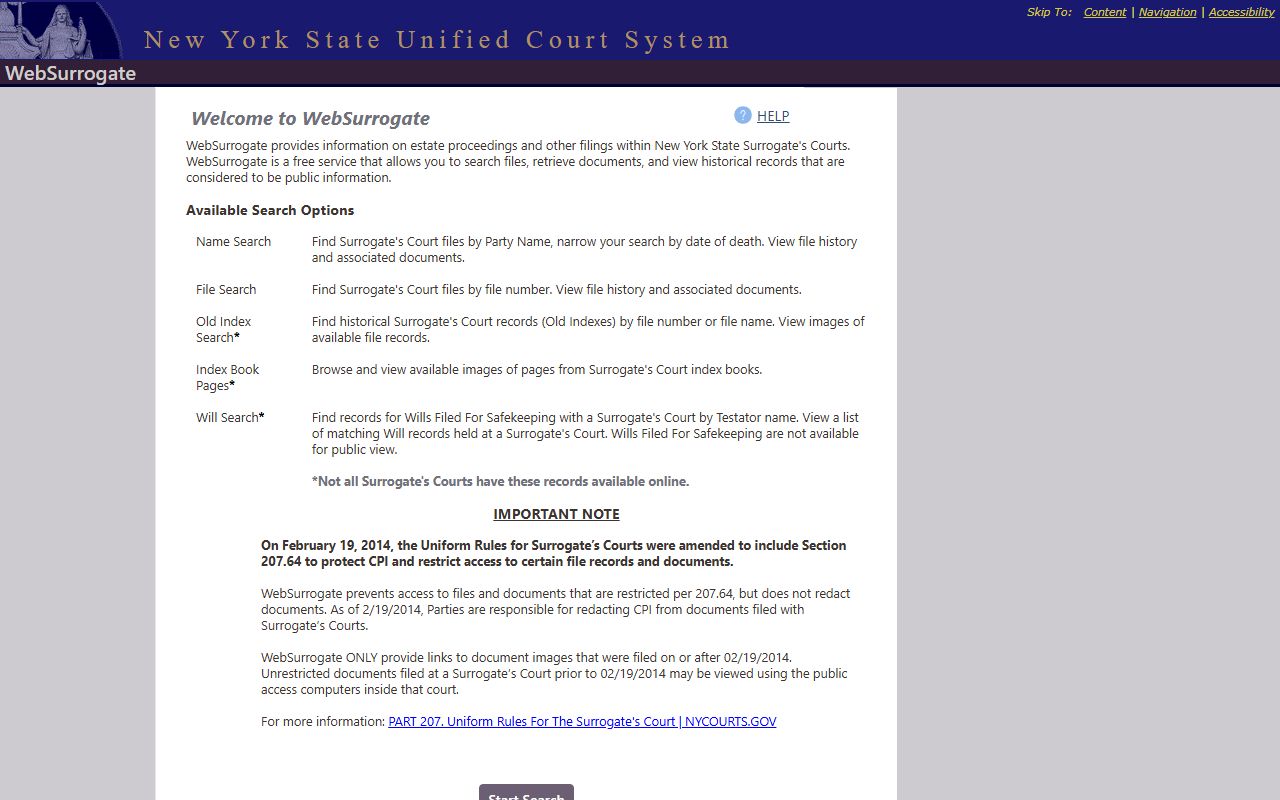
Estate files appear in WebSurrogate, the public search tool for Surrogate's Court records, shown below.
Source: WebSurrogate public estate search.
A few terms come up often in estate files.
- Testator
- The person who made the will.
- Executor
- The person named to carry out the will.
- Fiduciary
- An executor, administrator, or guardian with legal duties over an estate.
Suffolk County Court Records Fees
Copy fees at the County Clerk follow a set schedule. Certified copies cost more than plain ones, and a staff search adds a fee per two-year span. Payment is by certified bank check, money order, or attorney's check made out to the Suffolk County Clerk. Cash is taken only when you file in person.
| Item | Amount |
|---|---|
| Plain copy per page | $0.65 (min $1.30, max $40) |
| Certified copy per page | $1.25 (min $5, max $40) |
| Court records search | $5 per two years searched |
| Certificate on search of Clerk records | $9 |
| Statewide criminal records search | $52 (contact OCA) |
How to Interpret Suffolk County Court Records
Court files use shorthand. A charge is not the same as a conviction. An arrest or an indictment means the case was started, not proven. The disposition is the part that tells you the outcome, such as a guilty plea, a dismissal, or an acquittal. In civil cases, a judgment is the final result and may state money owed.
Watch the case status too. WebCivil marks cases as Open, active, restored, or All. A "minute" is the clerk's dated note of a court action. A "lis pendens" is a notice that a lawsuit affects a piece of real property. When in doubt about a code or an abbreviation, the clerk's office can explain what it means.
Accuracy and Record Limitations
Online court data can lag. WebCriminal itself warns of intermittent delays in updating case information, and it shows only cases with a future court date. Closed cases and warrants do not appear there. Sealed files drop out of public view. A name search can also return more than one person with the same name, so confirm the index number before you rely on a result.
Note: Always confirm case details with the court clerk or the County Clerk before you rely on an online record for any legal or financial decision.
History of Suffolk County Courts
Suffolk's court map reflects its history. The District Court became operational in January 1964. Before that, the five western towns of Babylon, Huntington, Smithtown, Islip, and Brookhaven each ran their own justice courts. The Uniform District Court Act moved that work to the new District Court and built a courthouse in each district plus a central First District location. The central building moved into the Cohalan Court Complex in Central Islip in 1993.
The eastern towns kept their justice courts, which is why "District Court" exists only in western Suffolk. The County Clerk's office, meanwhile, holds land records reaching back to the mid-1600s, stored in Riverhead and at the BOMARC facility in Westhampton.
Frequently Asked Questions
How do I search Suffolk County court records online?
Use the system for your court type. Supreme and County civil cases are in WebCivil Supreme. District civil cases are in WebCivil Local. Pending criminal dates are in WebCriminal. E-filed documents are in NYSCEF. Estates are in WebSurrogate. Land and court-minute records held by the elected clerk are in the Suffolk County Clerk Search Records portal.
Does WebCriminal show Suffolk County warrants?
No. The state court page says WebCrims shows only cases with a future court date. It does not show warrants or closed cases. If you think a warrant exists, contact the court, an attorney, or the relevant law enforcement agency.
Which Suffolk court handles divorce?
Only the Supreme Court grants divorces in New York. In Suffolk, matrimonial cases are heard mostly in Central Islip, while the signed decree is filed with the County Clerk in Riverhead.
More answers are on the Suffolk County Court Records FAQ page.