
What a Suffolk County Court Docket Shows
Think of a docket as the table of contents for a case. It records each step in order: the filing, the parties, motions, hearing dates, orders, and the final result. A docket points you to documents, but it is not the documents themselves. To read the actual papers, you often pull the file or use NYSCEF.
Dockets matter because they tell you a case status at a glance. You can see whether a case is open, what was last filed, and when the next court date falls. For Suffolk County court dockets, the level of online detail depends on the court and the case type.
The word "docket" gets used a few ways. It can mean the case file's running history, the list of cases set for a given day, or the clerk's index of filings. On this site, it means the running history of a single case. That history is what lawyers, parties, and the public check most often to follow a Suffolk County case from start to finish.
Suffolk County Civil Court Dockets
Civil dockets are the easiest to reach. WebCivil Supreme covers Supreme and County Court civil cases, and WebCivil Local covers District Court civil cases in the western towns. Both let you search by index number, party, attorney, or judge, and both can filter for cases with a future appearance. You can sort by court date and output the result as HTML or PDF.
The County Clerk also keeps court minutes, which work like a docket for many filed cases. New York law backs public access to clerk dockets.
Source: Judiciary Law § 255-B on public dockets.
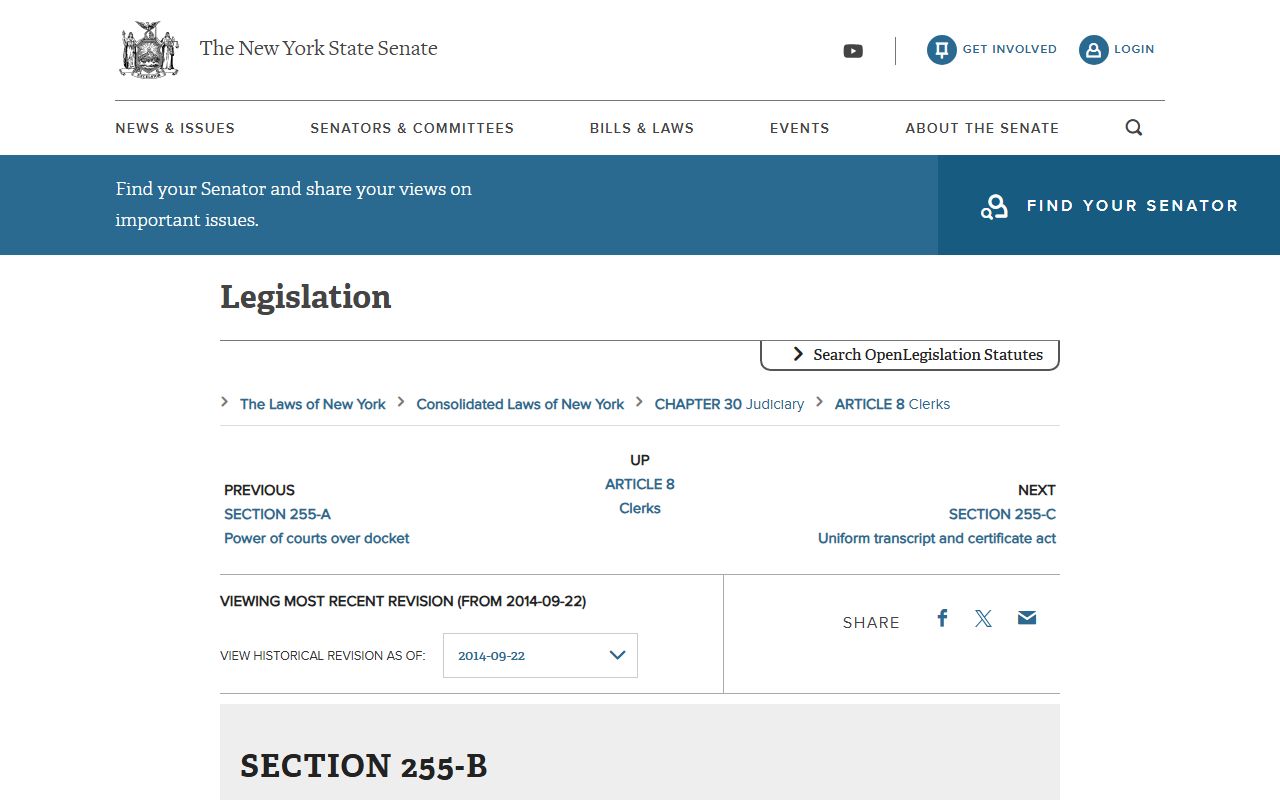
That statute supports the public court minutes and docket entries the Clerk maintains, subject to sealing rules.
Criminal Court Dates and Dockets
Criminal dockets work differently. WebCriminal shows pending criminal matters with a future court date. It does not show warrants or closed cases. You search by defendant name and pick a Suffolk court. This is the tool the state court system points to for finding the next date after an appearance.
The WebCriminal defendant search page is shown below.
Source: WebCriminal defendant search.
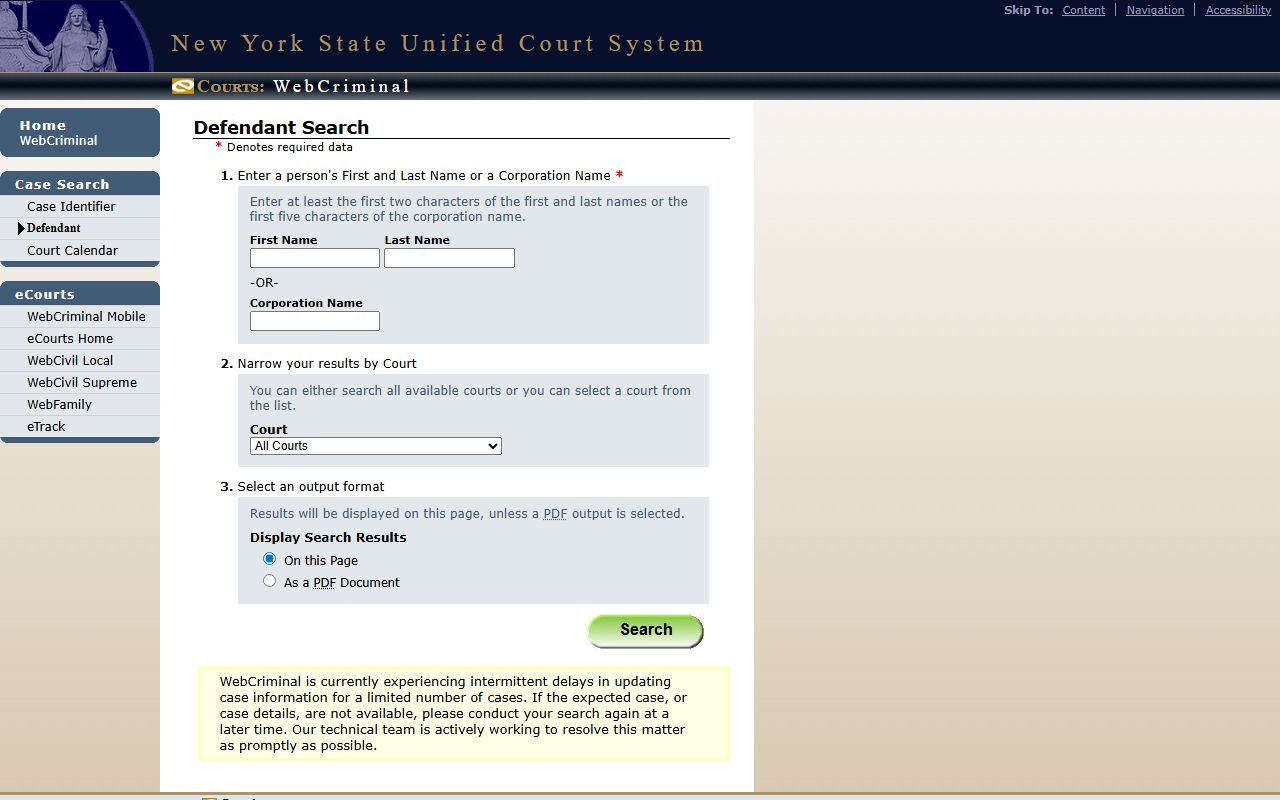
Because WebCriminal hides closed cases, a missing result does not mean a case never existed. It may have ended or never carried a future date.
The search needs only a little to start. For a person, you enter at least the first two letters of the first and last name. For a business, you enter at least the first five letters. You then pick a court, such as a Suffolk District, County, or Supreme criminal part, or search all courts at once. Results display on the page or as a PDF.
How to Read a Suffolk County Docket Entry
Clerk court minutes break a case into dated entries. Each line marks an action and may carry a notation. The table shows the fields you find in a Suffolk County court docket or minute record.
| Field | What It Shows |
|---|---|
| Index No | The case filing number. |
| Application Date | When the matter was filed. |
| Court | The court that holds the case. |
| Case Type | The kind of case, such as foreclosure or contract. |
| Plaintiffs / Defendants | The parties on each side. |
| Seq # and Minute | The order and text of each docketed action. |
| Notation | Notes tied to the entry, such as liber and page. |
Future Appearance and Status Filters
Both WebCivil tools let you limit a search to cases with a future appearance. That filter is handy when you only care about upcoming dates. You can also limit by case status, choosing Open, which covers active and restored cases, or All.
For a pending criminal date, the District Court adjourned-dates page explains how the next date is set and warns that you cannot get an adjournment by phone. Written adjournment requests need the case number, case name, and scheduled date.
Source: Suffolk District criminal adjourned dates.
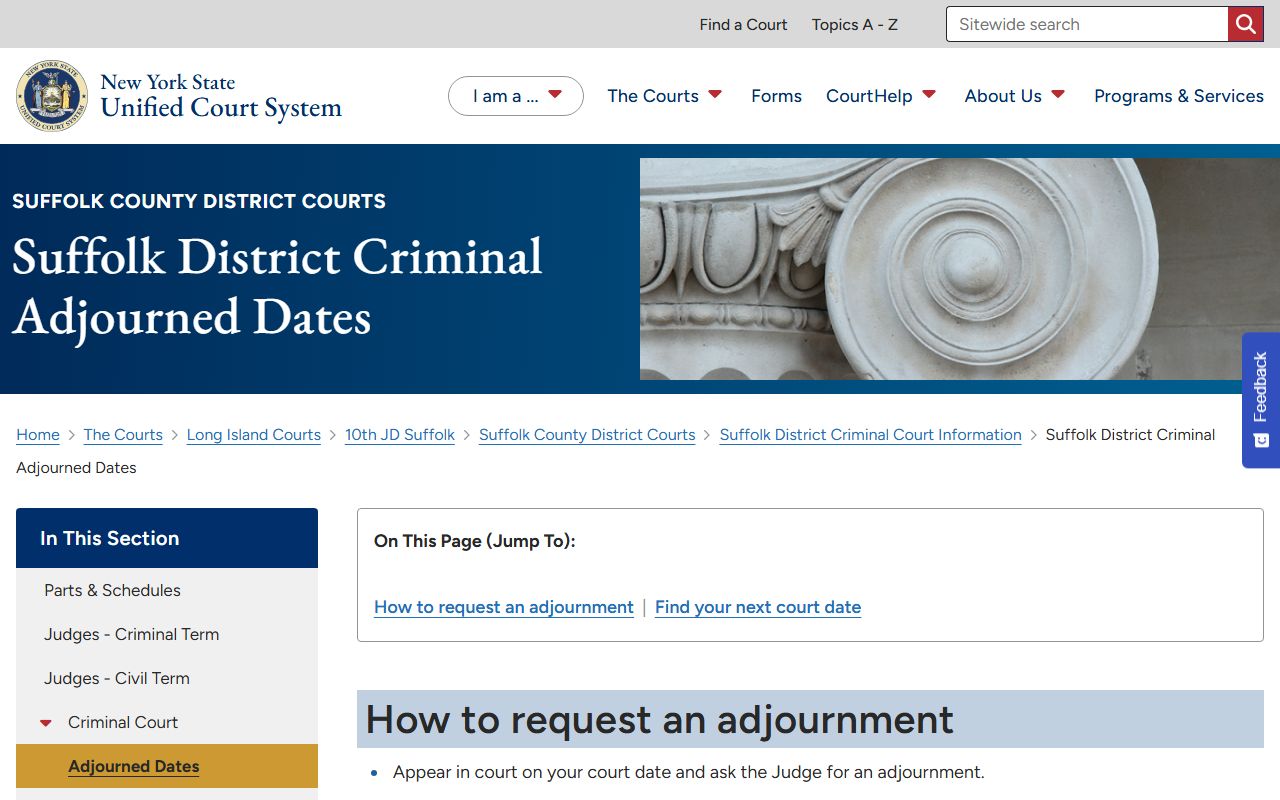
Note: A missed court date can lead a judge to issue a warrant, suspend a license, or forfeit bail, so confirm dates early.
Suffolk District Court Dockets by District
Local dockets in western Suffolk split across six districts. The First District holds the central criminal term in Central Islip and the civil term in Ronkonkoma. The Second through Sixth Districts map to single towns: Babylon, Huntington, Smithtown, Islip, and Brookhaven. When you search WebCivil Local, you pick the district for the town where the case was filed.
This split matters for a docket search. A landlord-tenant or small claims case is filed in the district for the town where the property or dispute sits. The criminal term in Central Islip handles arraignments every day of the year. So a civil docket and a criminal docket for the same town can live in two different buildings, even though both are District Court.
WebCivil Docket Search Fields
To pull a civil docket, you fill in a short search form. WebCivil Supreme and WebCivil Local share most of the same fields, with one key difference: the local tool adds a structured index number with case-type and court-code dropdowns. You can search by index number, party, attorney, or judge, then narrow the result. The table lists the fields you use most.
| Field Label | Type | Required | Notes / Format |
|---|---|---|---|
| Index Number | Text | No | Exact index number for the fastest result. |
| Party Name | Text | No | Plaintiff, defendant, or either role. |
| Attorney / Firm | Text | No | Search by counsel of record. |
| Court(s) | Multi-select | No | Suffolk County, Suffolk Supreme, or a District Court district. |
| Future Appearances | Radio | No | Limit to cases with an upcoming date. |
| Sort By | Dropdown | No | Index number, party, or court appearance date. |
Sorting by court appearance date is the quickest way to find an upcoming hearing on a busy docket. A name search alone can return several cases, so add the year of filing when you can.
Federal Court Dockets and PACER
Federal cases follow their own docket system. Suffolk County sits in the U.S. District Court for the Eastern District of New York, with a courthouse in Central Islip. Federal dockets and documents are not in the state portals. They live in PACER, the official paid federal electronic records system.
PACER charges a small per-page fee to view federal dockets and filings. A federal docket lists the same kinds of entries as a state one: parties, motions, orders, and hearing dates. If your matter is a federal crime, a civil rights claim, bankruptcy, or another federal case, the state docket tools will not show it. Use PACER instead, and see the Supreme Court page for more on the federal courthouse on Long Island.
Surrogate's Court File History
Estate cases keep a docket too. WebSurrogate shows file history and documents for many estate proceedings, with name, file number, and old index searches. Some documents stay restricted under court rule, and pre-2014 images are not always online.
For deeper estate searches, see the Surrogate's Court page. For the full case file behind a docket, see the court records page.
Dockets Versus Full Case Records
A docket and a full case record are not the same thing. The docket lists what happened. The case record holds the actual papers, like the complaint, motions, and orders. Online dockets can lag, and closed or sealed cases may not appear at all.
If a docket entry points to a document you need, request a copy from the County Clerk or pull it from NYSCEF when the case was e-filed. For criminal outcomes, a certificate of disposition comes from the court clerk, not from an online docket.
How Often Suffolk Dockets Update
Online dockets are not always current to the minute. WebCriminal warns that it has intermittent delays updating case information for some cases, and it advises searching again later if an expected detail is missing. Civil docket entries can also lag behind a recent filing or order.
Paper files move on a set schedule too. Surrogate's Court retrieves most paper estate files from off-site storage only at 10:00 a.m. and 2:00 p.m. each day, and requests made after 2:45 p.m. are handled the next business day. So a docket may point to a record that takes a day to reach the counter. When timing matters, call the court before you travel.