
The Suffolk County Clerk
The Suffolk County Clerk is an elected official, currently Vincent Puleo. The office handles the records people use when buying a home, paying off a mortgage, filing a lien or judgment, grieving taxes, or dealing with the courts. Its duties are set by the State Constitution and by state and local law.
The Clerk wears three main hats. It is the Registrar of Deeds, the Clerk of the County and Supreme Courts, and the County Records Management Officer. The office calls itself the busiest clerk's office in the state, recording hundreds of thousands of land, business, and court documents each year.
Suffolk County Clerk's Office
310 Center Drive
Riverhead, NY 11901
(631) 852-2000
Mon-Fri 9:00 a.m. to 5:00 p.m.
What the Suffolk County Clerk Records
The Clerk records a wide range of documents. On the land side, it holds deeds, mortgages, satisfactions, maps, and abstracts. On the financial side, it records judgments, liens, federal tax liens, and UCC filings. It also files business certificates, notary public records, and veterans' military discharge papers.
On the court side, the Clerk keeps court minutes and civil and criminal court records filed with the office. The land-record imaging system holds records imaged from 1987 to the present, while older land records reach back to the mid-1600s, stored in Riverhead and at the BOMARC facility in Westhampton.
The volume is striking. The office's 2025 annual report described about $496 million in revenue collected for the year, with $12.8 million delivered to the county General Fund. The Clerk also keeps a historic document library, supports apostille certification, and lists approved newspapers for LLC publication. For most residents, though, the day-to-day use is a deed, a mortgage satisfaction, a lien, or a court copy.
Clerk of the County and Supreme Courts
As Clerk of the County and Supreme Courts, the office is the records hub for those courts. This role is backed by state law. Judiciary Law § 255 requires the clerk to search court files on request and certify the result, which supports paid court-record searches and search certificates.
The clerk-duty statute is shown below.
Source: Judiciary Law § 255.
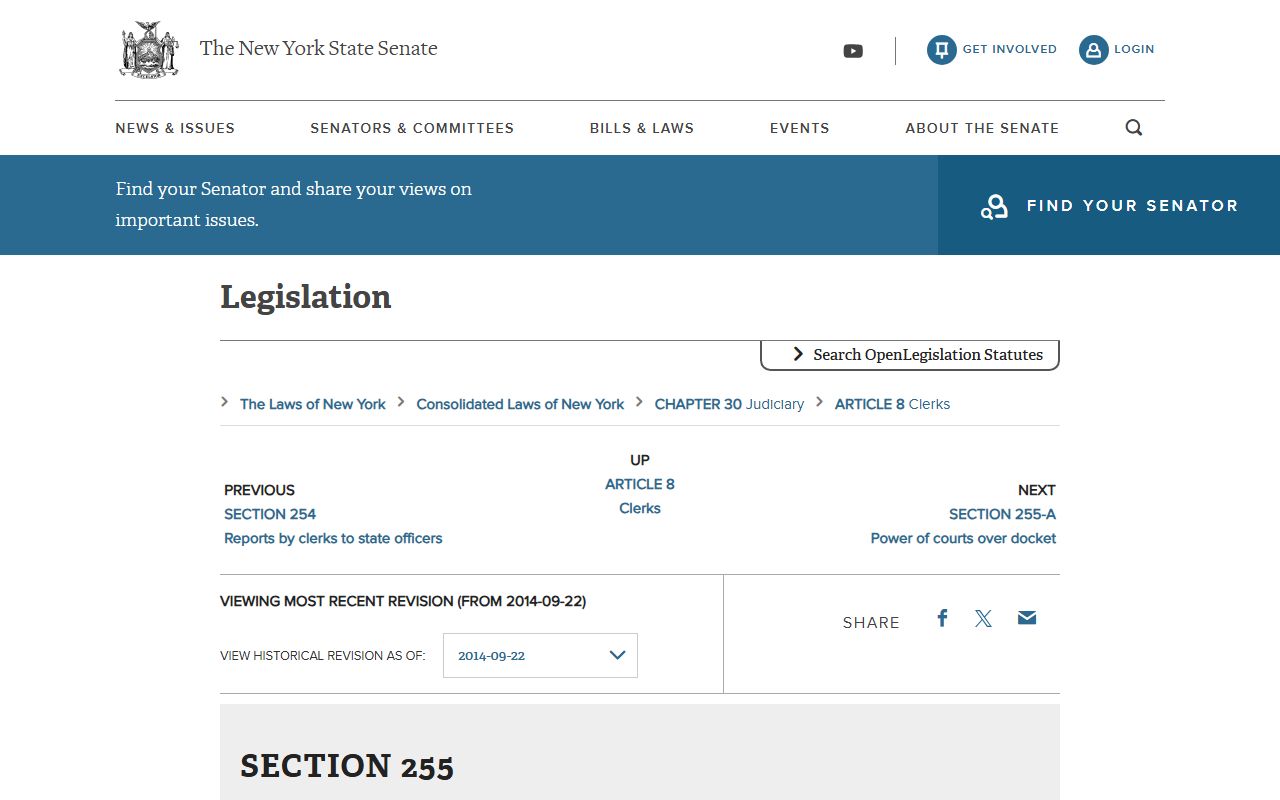
This is why the County Clerk, not the trial court, is often where you request a certified copy of a Supreme or County Court record.
Online Records and the Homeowner Watch List
The Clerk runs an online records system. A free search covers many record categories, while a paid enhanced service gives real-time access to view and print documents. The portal recently stopped supporting anonymized or VPN access, so plan to search without one.
One standout service is the Homeowner Watch List, or HOWL. It emails Suffolk homeowners when a deed or land-record filing affecting their property is recorded, which helps catch deed fraud early. New deeds may take 8 to 10 weeks after a purchase before HOWL registration works. For broader open-records guidance, see the public records page.
A practical tip on the online portal: it is built for direct use, not anonymized traffic. As of a late-2025 notice, the Clerk no longer supports VPN or anonymized access to the site. If a search fails, turning off a VPN often fixes it. The free search covers many record types, and you only pay when you choose the enhanced service to view and print documents.
How to Request a Certified Copy
You can request copies in person or by mail. For court action copies, the Clerk has a clear process. Follow these steps.
- Identify the record and the index number if it is a court action.
- Complete the matching Clerk order form or write a request with the document details.
- Include payment by certified check, money order, or attorney's check payable to the Suffolk County Clerk.
- Add a self-addressed stamped envelope and a copy of your photo ID where required.
- Mark court action requests Attn: Court Actions and mail them to the Clerk in Riverhead.
The Clerk's copy request page explains the mail requirements.
Source: Suffolk County Clerk copies of documents.
Records Request Form Fields
The Clerk order forms ask for the details that let staff find and certify the right document. For a court action such as a divorce, the form covers the case and the copies requested. The table lists the common fields.
| Field Label | Type | Required | Notes |
|---|---|---|---|
| Index Number | Text | If known | Year and number for a court action. |
| Party Names | Text | Yes | Names at the time of filing. |
| Document and copy type | Checkbox | Yes | Certified or plain, with a count. |
| Index Number Search | Checkbox | No | $5 per two years if staff must search. |
| Signature | Signature | Conditional | Notarized for restricted court records. |
| Mailing Address | Address | Yes | Return and contact address. |
Suffolk County Clerk Fees
Clerk copy fees follow a set schedule, with separate rules for court actions. Payment is by certified check, money order, or attorney's check, and a returned check carries a $20 fee. The table shows common fees.
| Item | Fee |
|---|---|
| Certified copy by Clerk | $1.25 per page (min $5, max $40) |
| Plain copy | $0.65 per page (min $1.30, max $40) |
| Court records search | $5 per two years |
| Certificate on search of Clerk records | $9 |
| UCC filing (one debtor) | $25 |
| Federal tax lien certified copy | $10 |
| Returned check | $20 |
The certified-copy fee schedule is shown below.
Source: Suffolk County Clerk certified copy fee schedule.
Note: Cash is accepted only when you file in person; mail requests must use a certified check, money order, or attorney's check.
Directions, Hours, and Photo ID
The Clerk's public records office is at 310 Center Drive in Riverhead, with the public office at 300 Center Drive. Photo ID is required to enter, and the public must use the main entrance. The office is open Monday through Friday, 9:00 a.m. to 5:00 p.m., and staff recommend arriving by 4:45 p.m. so they have time to help.
From the west, take the Long Island Expressway to Exit 71 and head south on Route 24 toward the County Center. The Clerk also keeps a satellite office at the Central Islip courthouse to serve the legal community, and it stores records at both the Riverhead campus and the BOMARC facility in Westhampton. For directions to the wider court campus, see the Supreme Court page.
The Court System's Chief Clerks
The elected County Clerk is not the only clerk in the system. Each state court in Suffolk also has its own chief clerk and operational clerk office under the New York State Unified Court System. These court clerks handle case filing, calendars, and in-court records, separate from the County Clerk's records role.
For example, the District Court chief clerk's office sits in the Cohalan Court Complex in Central Islip, the Supreme Court has its own chief clerk in Riverhead, and the County Court chief clerk's office handles felony case records. When you need a case file, the County Clerk holds many Supreme and County Court records, while the court's own clerk handles active case matters. The court records page explains which tool to use for each.
The simple way to remember it: the elected County Clerk is the records custodian, and the court chief clerks run the courtrooms. A certified copy of a filed Supreme or County Court record usually comes from the County Clerk. A question about an active case, a calendar, or a courtroom usually goes to that court's chief clerk. Knowing which clerk to call saves a transfer and a wait.