
Is There a Suffolk County Warrant Search Online?
No official public warrant portal or active warrant list was found on the Suffolk County Sheriff pages. That gap is normal. Most agencies do not publish a live warrant list, since doing so could tip off people the courts want to bring in. So a Suffolk County warrant search is not a single click.
Instead, you confirm a warrant through the court that would have issued it, through an attorney, or through law enforcement. Acting early matters. A warrant does not expire on its own, and it can surface during a traffic stop, a license renewal, or a background check.
WebCriminal Does Not Show Warrants
This is the key point many searchers miss. WebCriminal shows pending criminal cases with a future court date. It does not show warrants or closed cases. So an empty WebCriminal result is not proof that no warrant exists. A bench warrant for a missed date may not appear there at all.
The state court page for Suffolk District criminal cases states this directly. It also explains that a missed date can lead a judge to issue a warrant, suspend a license, or forfeit bail.
Note: Absence from WebCriminal does not mean there is no warrant, so confirm directly with the court if you have any doubt.
Types of Suffolk County Warrants
Warrants come in several forms, and each starts in a different way. Knowing the type points you to the right office to resolve it. The list below covers the common ones.
- Arrest warrant - brings a person before a court on criminal charges.
- Bench warrant - issued by a judge, often after a missed court date or an order violation.
- Family offense warrant - handled in part by the Sheriff Family Court Bureau and Warrant Squad.
- Child support warrant - handled by the Sheriff's Warrant Apprehension Program.
- Fugitive warrant - received from agencies in other counties or states.
- Search warrant - an investigative warrant, usually not public before it is executed.
The Sheriff Warrant Bureau
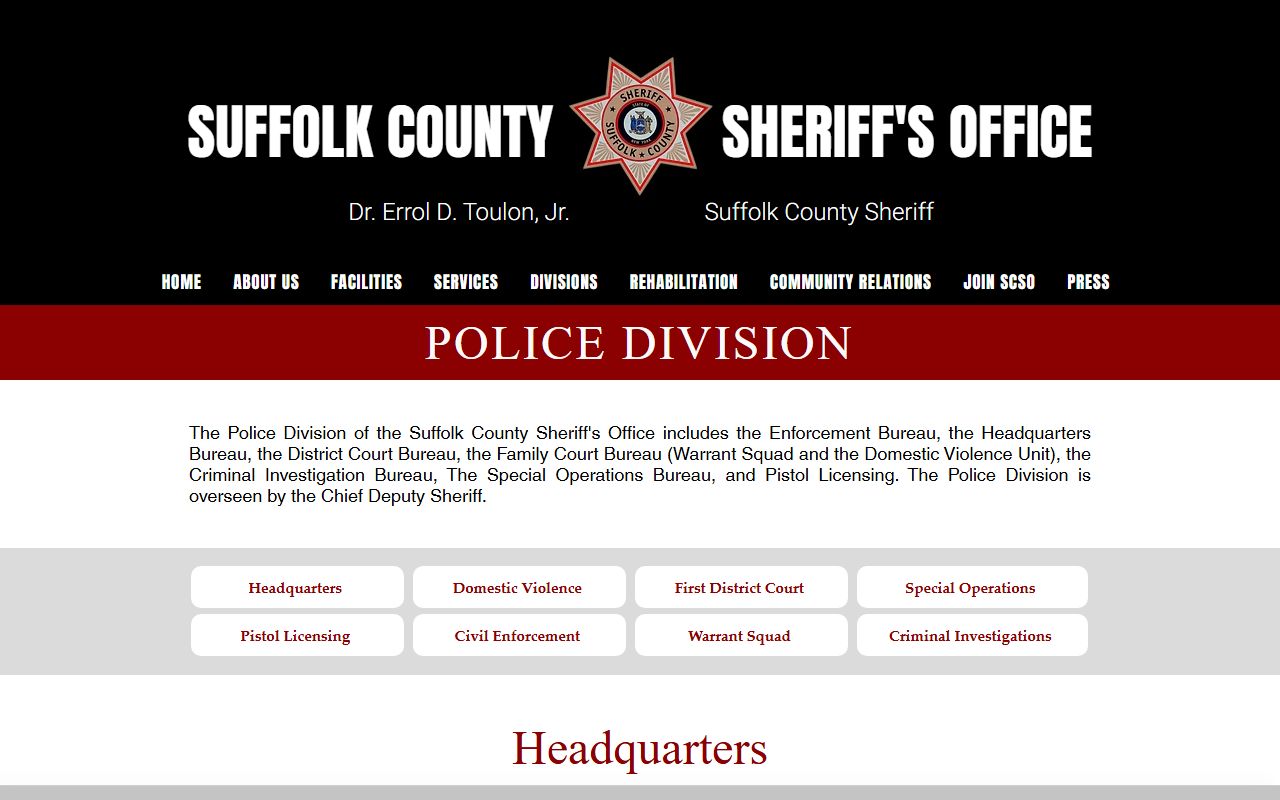
The Suffolk County Sheriff's Police Division runs the Warrant Bureau. It includes sections for Family Offense and Abuse, Juvenile, General Services, the Sheriff's Warrant Apprehension Program for child support, and Criminal Warrants. The Domestic Violence Unit serves and enforces orders of protection across the county and executes related arrest warrants.
The Warrant Bureau assists police agencies across Suffolk, including town and village departments, the District Attorney's Office, Nassau County, and New York City, and it receives fugitive warrants from agencies nationwide. The Police Division page outlines this work.
Source: Suffolk County Sheriff Police Division.
Because warrants flow through several bureaus, the issuing court is still the best place to confirm the status of your own case.
Family Offense and Child Support Warrants
Some Suffolk warrants come out of Family Court rather than a criminal case. The Sheriff's Family Court Bureau runs a Warrant Squad that works alongside the Domestic Violence Unit. That unit serves and enforces orders of protection across the county, arrests people charged with violating those orders, removes alleged abusers, and seizes weapons where the court directs.
Child support has its own track. The Sheriff's Warrant Apprehension Program handles child-support warrants, which a court can issue when a person ignores a support order or a scheduled appearance. These are civil in origin but can lead to arrest. If you face one, the issuing Family Court and your attorney are the right first contacts, not a criminal court clerk.
Because these warrants flow through Family Court, many of the underlying records are restricted from public view. The warrant itself is enforced by the Sheriff, while the case behind it stays confidential under Family Court rules.
What a Suffolk County Warrant Record Contains
There is no public Suffolk warrant database to browse, so the fields below describe what a warrant record generally holds inside court and law enforcement systems, not a search form you can use. Knowing the parts helps when you talk to the court or an attorney about clearing one.
- Name and date of birth of the person named in the warrant.
- Issuing court and the docket or case number.
- Warrant type, such as arrest, bench, family offense, or child support.
- The charge or basis for the warrant.
- Issue date and any bail or bond amount set.
- The agency holding the warrant and its current status.
You cannot pull these details from a public website. The court that issued the warrant, or counsel acting for you, can confirm them.
How to Resolve a Suffolk County Warrant
Clearing a warrant takes a careful, step-by-step approach. Do not ignore it, and do not rely on an online search alone. The steps below outline a safe path.
- Do not rely on WebCriminal; it does not show warrants or closed cases.
- Identify the issuing court from prior paperwork, a missed-appearance notice, your attorney, or the agency that contacted you.
- Contact an attorney, Legal Aid, or Assigned Counsel before appearing on a criminal warrant if you may be eligible.
- Contact the court clerk for instructions; a written adjournment request needs the case number, case name, and date.
- Plan for bail. A voluntary surrender through counsel can reduce surprises and allow bail planning.
- After resolution, confirm the warrant recall with the issuing court and the relevant agency.
Bail on a Warrant
If a judge sets bail on a warrant, Suffolk has set posting rules. Bail can be posted at the Riverhead facility around the clock and at Yaphank from 7:00 a.m. to 10:30 p.m. All bonds and any bail after 10:30 p.m. go through Riverhead only. Accepted payments include cash, bank check, cashier check, and credit card, and credit cards add a 7% charge.
For full booking and bail details, see the inmate records page. A warrant tied to an arrest may also create an arrest record and a criminal case.
Fugitive and Out-of-County Warrants
Warrants do not stop at the county line. The Suffolk Sheriff's Warrant Bureau assists police agencies across the county, town and village departments, the District Attorney's Office, Nassau County, and New York City police and sheriff departments. It also receives fugitive-from-justice warrants from agencies across the United States.
This reach matters for two reasons. First, a warrant from another state can be acted on in Suffolk. Second, a Suffolk warrant can follow a person who moves away. So clearing a warrant where it was issued is the only reliable fix. Ignoring one and relocating does not make it go away, and it may surface at the worst time, such as a border crossing or a job background check.
Missed Court Dates and Bench Warrants
The most common Suffolk warrant is the bench warrant for a missed court date. The District Court explains that when a person fails to appear, the judge decides whether to adjourn the case or to issue a warrant, suspend the license, or forfeit bail. A phone call to the courthouse will not adjourn a case.
If you cannot make a date, a written adjournment request must reach the court before the date and must list the case number, the case name, and the scheduled date. Acting in advance is far better than missing the date and dealing with a warrant later. An attorney can often arrange a new date or a surrender that avoids a public arrest.
Getting Help With a Warrant
You do not have to face a warrant alone. The Legal Aid Society of Suffolk County and the Assigned Counsel Defender Plan represent eligible residents. For general guidance on court process, the state runs a self-help site that walks through criminal, family, and other matters.
Source: New York CourtHelp.
Cost should not be a barrier. The Legal Aid Society of Suffolk County and the Assigned Counsel Defender Plan represent eligible residents in criminal and family matters, and the plan can connect non-citizens with immigration counsel through a regional assistance center. Reaching out before a court date, rather than after a warrant issues, gives counsel time to plan a surrender and a bail strategy.
For DUI, DWI, or missed traffic dates that can trigger a warrant, see the traffic court records page.