
How Marriage and Divorce Records Work in Suffolk County
Four records get mixed together here, so it helps to separate them. A marriage license is issued before the wedding by a town or city clerk. A marriage certificate is the later proof, held by the state and the issuing clerk. A divorce decree is the court order ending the marriage, filed with the County Clerk. A divorce certificate is a short state record of the dissolution.
Each one comes from a different place. Suffolk has ten towns, and the town clerk that issued a marriage license is the first stop for that record. Divorce, by contrast, runs only through the Supreme Court. Sorting out which record you need is half the work.
The mistake people make is assuming one office holds everything. It does not. A marriage license is local, a marriage certificate is state and local, a divorce decree is a court record at the County Clerk, and a divorce certificate is a state vital record. Each carries its own request process, its own fee, and its own access rules, so name the exact record before you start.
Marriage Licenses Through Town Clerks
New York handles marriage licenses at the local level outside New York City. In Suffolk County, the town or city clerk that issued the license keeps that record. The towns are Babylon, Brookhaven, East Hampton, Huntington, Islip, Riverhead, Shelter Island, Smithtown, Southampton, and Southold. To get a marriage record, you identify the issuing town first.
The general steps to apply for a license are similar across towns.
- Find the town or city clerk where you will marry or where the license was issued.
- Both partners usually apply together in person with valid photo ID.
- Provide proof of identity and any documents the clerk requires.
- Pay the town's license fee, which is set locally.
- Observe any waiting period before the ceremony.
Fees and exact documents vary by town, so confirm with the issuing clerk before you go.
New York Marriage Certificates
A marriage certificate is the official proof that a marriage took place. Outside New York City, the state Department of Health and the issuing town clerk hold these records. The state's marriage page explains how to request a certified marriage certificate and who is eligible.
Source: New York Department of Health marriage records.
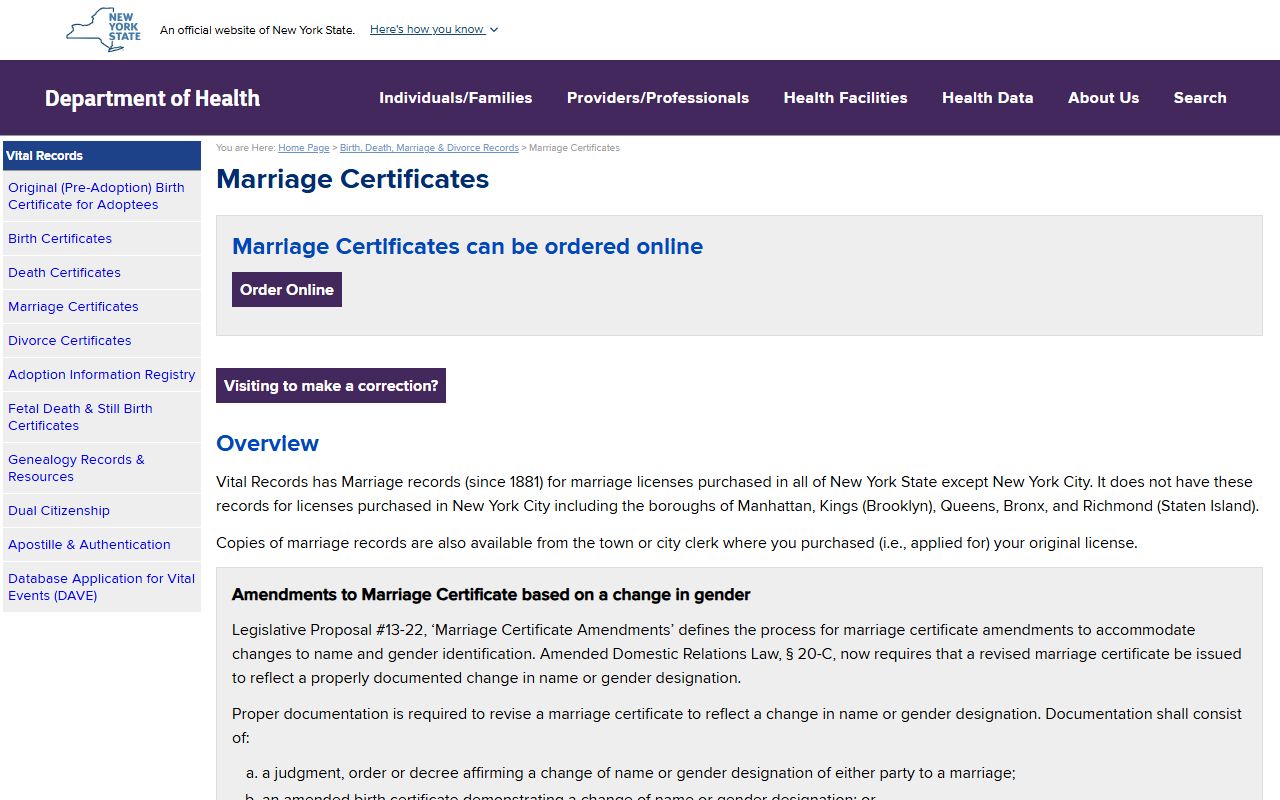
If you only need proof of the marriage, the certificate route is usually simpler than pulling a full court file. Eligibility rules apply, since a certified marriage certificate is generally limited to the spouses and certain others with a documented need. The state page lists who qualifies and what identification a request requires.
Divorce Is Handled by the Supreme Court
Only one court grants divorces in New York: the Supreme Court. In Suffolk, matrimonial cases are heard predominantly in Central Islip, while other civil matters sit in Riverhead. So a Suffolk divorce case starts in Supreme Court, and the signed decree is then filed with the County Clerk, usually in the county where the plaintiff lived.
The state runs a divorce portal with uncontested divorce resources and forms.
Source: New York Courts divorce portal.
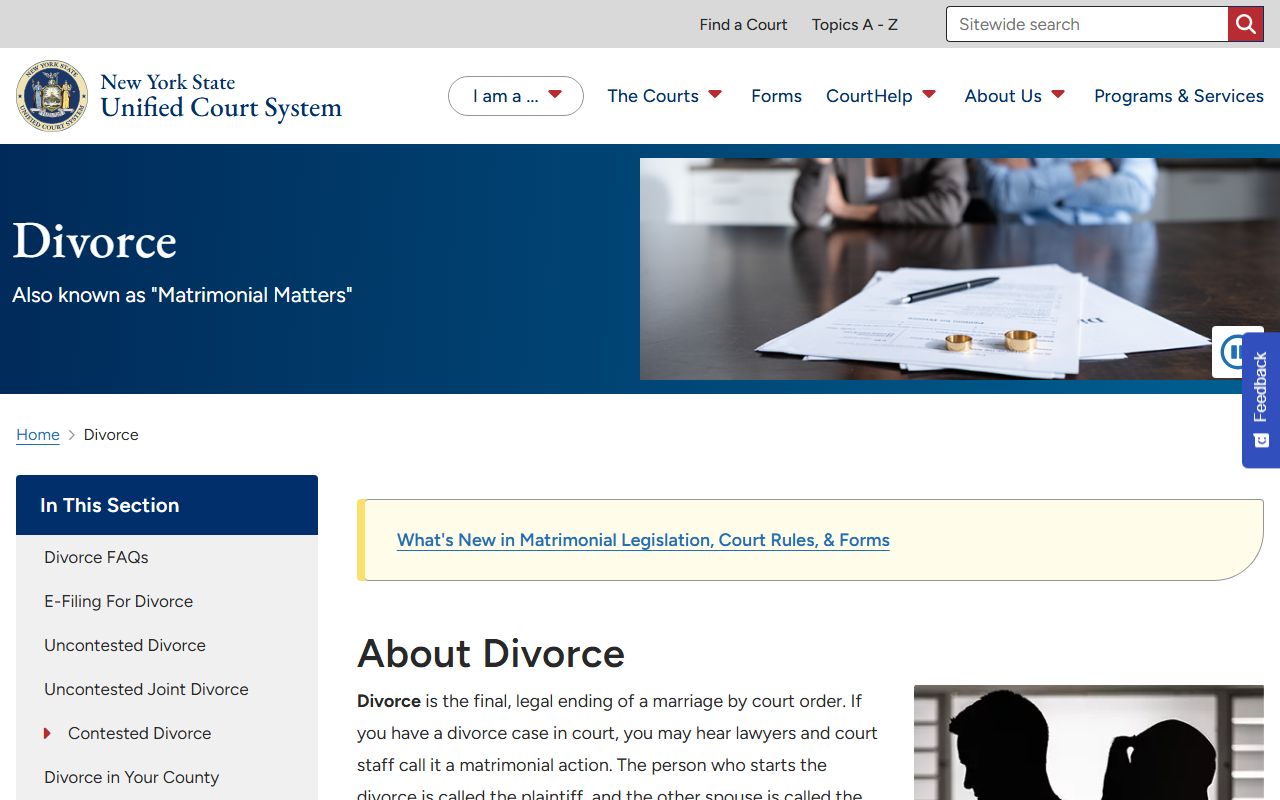
That portal is the right starting point for filing, while record copies come from the County Clerk.
Divorce Decree Versus Divorce Certificate
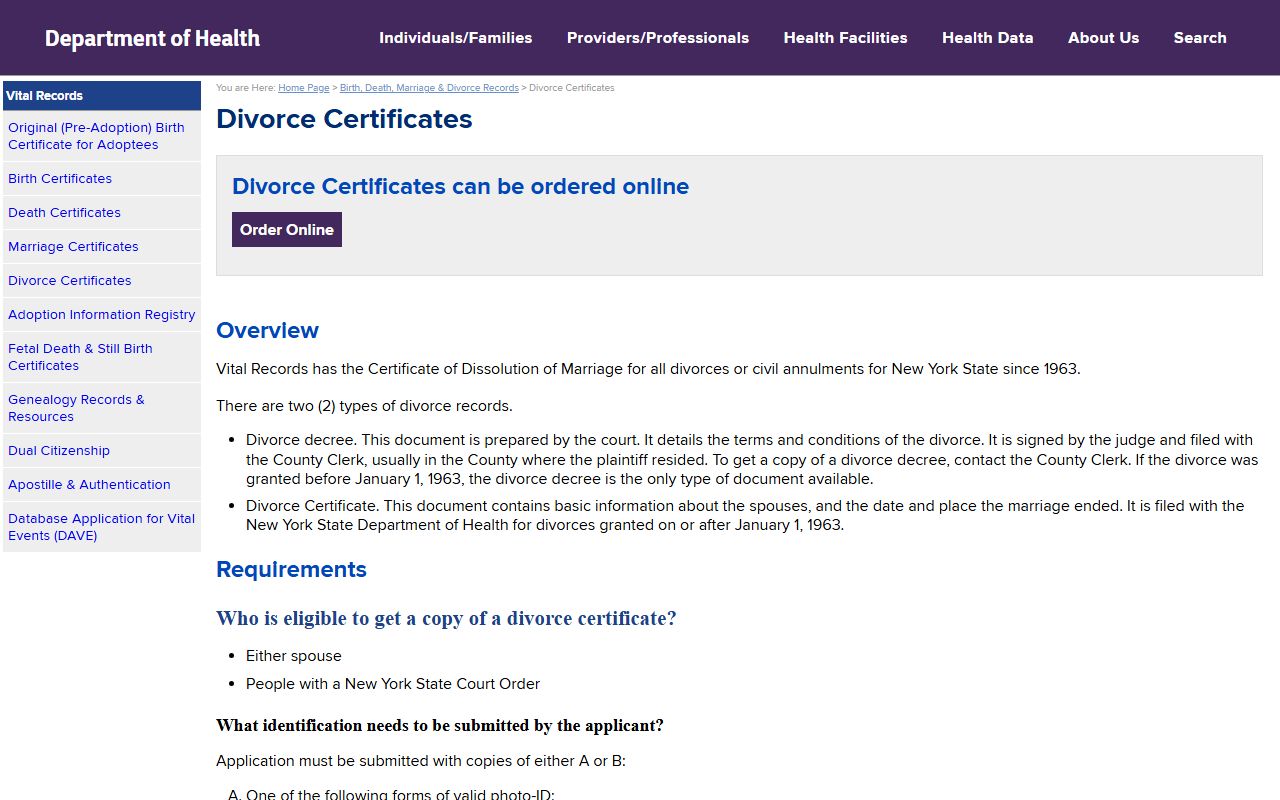
These two records are not the same, and people often request the wrong one. The decree is the full court order with all the terms. The certificate is a short state record with basic facts. The table compares them.
| Point | Divorce Decree | Divorce Certificate |
|---|---|---|
| Prepared by | The court; signed by the judge | State vital records |
| Held by | Suffolk County Clerk | NY Department of Health |
| Contains | Full terms and conditions | Basic spouse info and date the marriage ended |
| Coverage | The full case file | Divorces since January 1, 1963 |
The state divorce records page explains the certificate side.
Source: New York Department of Health divorce records.
How to Get a Suffolk Divorce Decree Copy
The decree is held by the County Clerk, and access is limited. Certified copies go only to the parties, an attorney of record, or someone with a court order. The request must be notarized and include a photo ID copy. Follow these steps.
- Confirm the divorce was filed in Suffolk County Supreme Court and find the index number if you can.
- Use the County Clerk divorce, stipulation, and QDRO order form or a written request.
- Include the index number, both party names at the time of divorce, a notarized signature, payment, a self-addressed stamped envelope, and a photo ID copy.
- Mark the mail Attn: Court Actions and send it to the Suffolk County Clerk in Riverhead.
- If the index number is unknown, request a Clerk staff search at $5 per two years.
Divorce Copy Request Form Fields
The County Clerk order form asks for specific details so staff can match the right file. The table lists the main fields on the divorce, stipulation, and QDRO order form.
| Field Label | Type | Required | Notes |
|---|---|---|---|
| Index Number (year and number) | Text | If known | Separate year and number fields. |
| Plaintiff | Text | Yes | Name at the time of divorce. |
| Defendant | Text | Yes | Name at the time of divorce. |
| Copy type and count | Checkbox | Yes | Certified or plain, number of copies. |
| Index Number Search | Checkbox | No | $5 for every two years searched. |
| Signature | Signature | Yes | Must be notarized or the request is rejected. |
| Mailing Address | Address | Yes | Return and contact address. |
Divorce Record Copy Fees
The County Clerk copy fees follow a set schedule. A staff search adds a fee when you do not have the index number. Payment is by certified check, money order, or attorney's check payable to the Suffolk County Clerk.
| Item | Fee |
|---|---|
| Certified copy | $1.25 per page (min $5, max $40 per document) |
| Plain copy | $0.65 per page (min $1.30, max $40 per document) |
| Index search by Clerk staff | $5 per two years searched |
| Filing a separation agreement | $5 |
| Minimum certified divorce judgment | $5 plus possible page charges |
Residency and Grounds for Divorce
Before a Suffolk divorce can be filed, the case must meet residency and grounds rules. Residency is met if either spouse lived in New York continuously for at least two years before filing. Shorter periods can work in some cases, such as one year combined with a New York marriage or New York grounds, or when both spouses are New York residents on the filing day and the grounds happened in the state.
New York recognizes several grounds, including cruel and inhuman treatment, abandonment, imprisonment for three or more years, adultery, living apart under a judgment or agreement, and an irretrievable breakdown for at least six months. The last ground is the no-fault basis used in most modern cases.
These rules decide whether a Suffolk court can even hear the case. If neither spouse meets the residency test, the court may not have authority, no matter how clear the grounds. The state divorce portal and CourtHelp resources walk self-represented spouses through both tests before filing, which saves a rejected petition later.
Confidentiality of Suffolk Matrimonial Records
Divorce files are confidential by law. Under Domestic Relations Law § 235, matrimonial records are not open to the public, which is why the County Clerk limits divorce decree copies to parties, attorneys of record, and people with a court order. Older records may open after statutory periods, but current files stay restricted.
The County Clerk page on separation agreements and divorce decrees spells out these copy restrictions.
Source: Suffolk County Clerk divorce decree records.
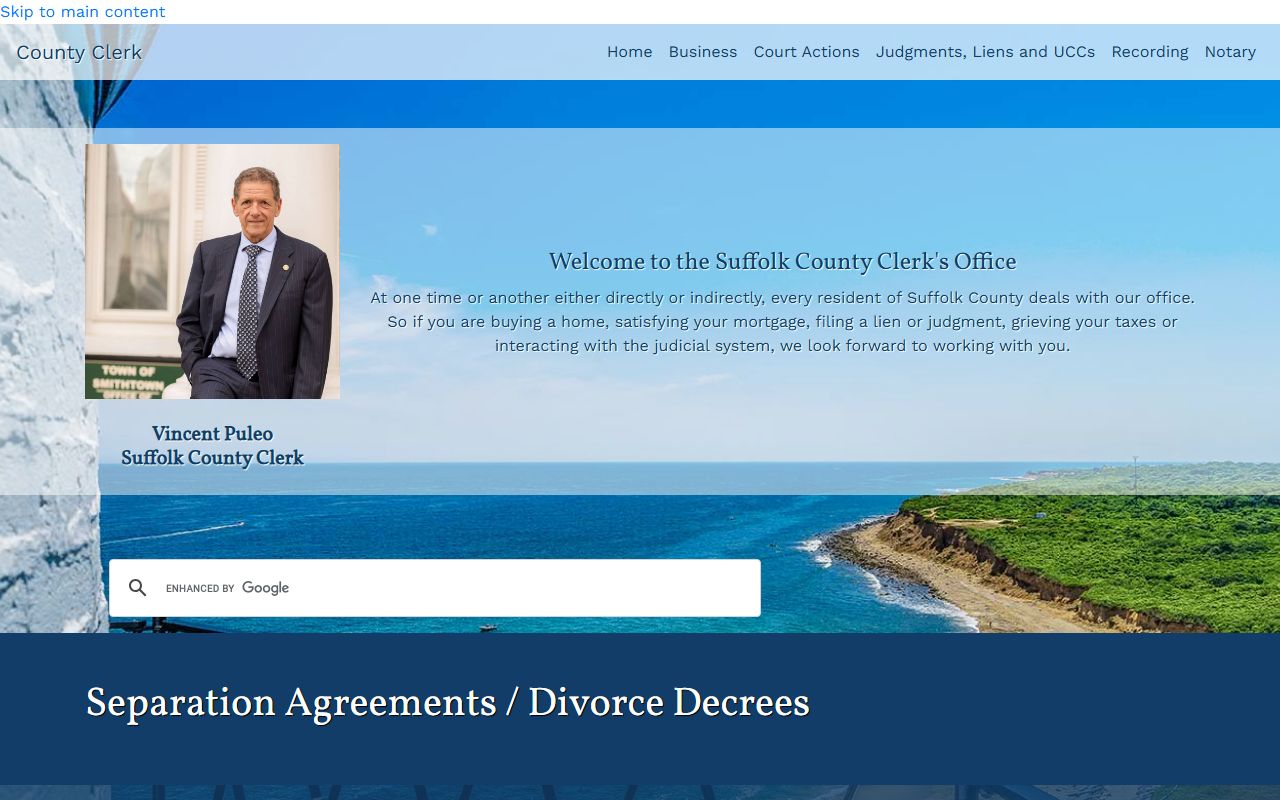
For the court that grants divorces, see the Supreme Court page, and for the records office, see the County Clerk page. Estate matters go to Surrogate's Court.