
How to Find Suffolk County Arrest Records
Start with custody. When someone is arrested in Suffolk County, they may be booked into the Riverhead or Yaphank correctional facility. The Sheriff does not post a public online roster, so custody details come by phone from Central Records at (631) 852-2241, open around the clock, or through a FOIL request. For a pending case, the court system shows the next criminal date.
Use these steps to track a recent arrest.
- Call Central Records for current custody and booking confirmation; have the person's date of birth ready.
- Check WebCriminal for a pending criminal court date in a Suffolk court.
- File a Sheriff FOIL request for incarceration records held by the county jails.
- For full case history, pull the file through the court records page.
A booking record and a court record are two different files, so you may need both. Timing helps too. A person arrested today may not show up in any court system until after arraignment, while custody is confirmed right away by phone. If the arrest happened in another county or state, search that jurisdiction, since Suffolk records cover Suffolk cases.
Arrest Record Versus Criminal Court Record
People mix these up often. An arrest record sits with law enforcement and the jail. A criminal court record sits with the court that handles the charge. They tell different parts of the same story, and you may need to search both. The table compares them.
| Point | Arrest Record | Criminal Court Record |
|---|---|---|
| Held by | Sheriff and police agencies | County or District Court |
| Shows | Booking, custody, charge at arrest | Charges, plea, sentence, disposition |
| How to access | Central Records, Sheriff FOIL | WebCriminal, certificate of disposition |
| Outcome | Does not show final result | Shows how the case ended |
Charges Versus Convictions
This difference is the heart of reading any arrest record. A charge is an accusation. A conviction is a guilty finding or plea. An arrest, an indictment, or a pending charge does not mean a person was found guilty. Many cases end in dismissal, reduction, or acquittal.
County Court runs felony cases outside New York City. District Court handles misdemeanors and felony arraignments in the western towns. The Suffolk County District Attorney prosecutes these cases, and an eligible defendant can get a public defender. The DA's official site explains its role.
Source: Suffolk County District Attorney.

The disposition in the court file, not the arrest, tells you whether a charge ended in a conviction. This is why a fair read of any arrest record waits for the outcome before drawing a conclusion about guilt.
Mugshots and Booking Information
Suffolk does not run a public mugshot gallery. Booking photos and details may be available through a Sheriff FOIL request, which generally covers incarceration records for people held in Suffolk correctional facilities. Requests for police reports, accident reports, or 911 transcripts go to the Suffolk County Police Department instead.
To file a Sheriff FOIL request, you complete the first section online, print it, sign it, and submit it to the Freedom of Information Officer at the Sheriff's Office in Riverhead. The office generally provides incarceration records only for people held in Suffolk correctional facilities. Records that the Sheriff does not keep, such as a road patrol arrest report, come from the agency that made the arrest.
For people in state prison or federal custody, the arrest itself is local but the custody record is separate. See the inmate records page for jail custody and the released inmates page for state and federal locators.
What Arrest Records Are Public or Restricted
Not every arrest stays public. When a criminal case ends in favor of the accused, the record is sealed under Criminal Procedure Law § 160.50. Sealing covers fingerprints, photos, and police and court records tied to that case. Juvenile and youthful offender matters are also restricted. Some noncriminal convictions are sealed under Criminal Procedure Law § 160.55.
The official sealing statute is shown below.
Source: Criminal Procedure Law § 160.50.
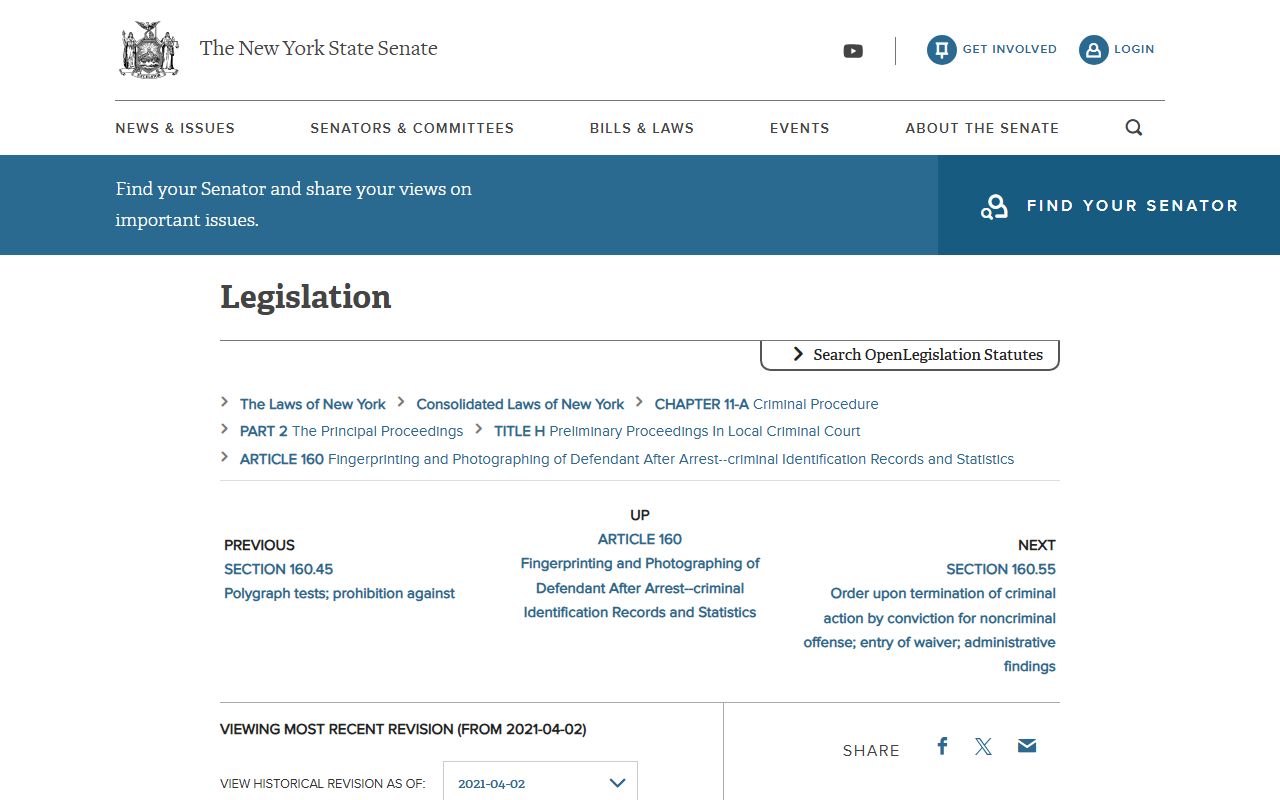
Note: A sealed arrest will not appear in ordinary public searches, though law enforcement and certain licensing checks may still access it under statute.
Sealed Versus Expunged in New York
New York is a sealing state more than an expungement state. The two are not the same. Sealing hides a record from public view but keeps it on file for limited uses. Expungement destroys a record, which New York rarely does outside specific cannabis relief.
| Point | Sealed | Expunged |
|---|---|---|
| Record exists | Yes, but hidden from public | Destroyed or removed |
| Common in NY | Yes | Rare; mainly cannabis cases |
| Who can still see it | Law enforcement, some agencies | Generally no one |
| How it happens | By law or by petition | By specific statute |
For old convictions, an eligible person can petition the sentencing court to seal under Criminal Procedure Law § 160.59, with notice to the district attorney.
Statewide Criminal Records and Background Checks
A full criminal background check reaches beyond Suffolk. The state Office of Court Administration runs a statewide criminal history search, and the County Clerk lists that $52 OCA search on its court action fee schedule. The state also runs a public sex offender registry for Level 2 and Level 3 offenders.
The DCJS sex offender registry search is shown below.
Source: New York DCJS sex offender registry.
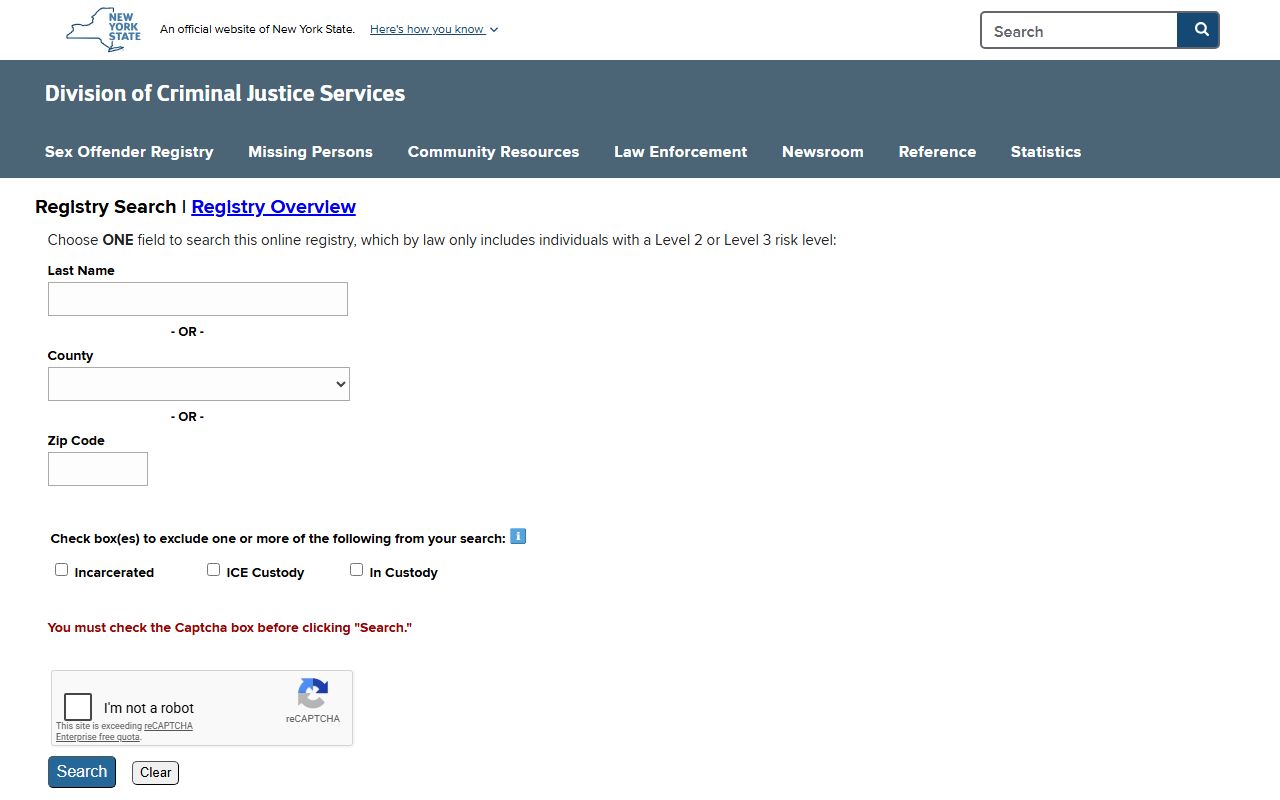
For Level 1 or risk-pending information, the registry directs callers to a phone line with the person's name and another identifier. A public registry profile can show multiple photos, names and aliases, home or work addresses, the conviction that requires registration, and the assigned risk level.
County Court Felonies and District Court Misdemeanors
Suffolk splits criminal cases by level and by place. County Court runs felony trials outside New York City and can also handle lesser offenses. Its records can include the indictment or superior court information, arraignment entries, bail or remand terms, plea entries, sentencing minutes, and a certificate of disposition. County Court also hears Extreme Risk Protection Order applications during business hours.
District Court is the local criminal court in the five western towns. It handles misdemeanors, lesser offenses, and felony arraignments and preliminary matters, plus traffic tickets that charge a crime. Its criminal term sits in the Cohalan Court Complex in Central Islip, where arraignments run every day of the year. The eastern towns use town and village justice courts for local criminal matters instead.
So the same arrest can touch more than one court. A felony may start with a District Court arraignment and move to County Court for trial. To follow it, you may search more than one court in WebCriminal.
Certificates of Disposition
A certificate of disposition is the official proof of how a criminal case ended. It is not the same as an online search result. Employers, immigration filings, and licensing boards often ask for one. The court clerk that handled the case issues it, not the DMV or a private site.
To get one, contact the court that holds the case with the defendant name, the docket or index number, and the approximate date. For a statewide criminal history, the Office of Court Administration runs a paid search, listed at $52 on the County Clerk's court action fee schedule. A certificate of disposition reflects only the case from that one court, so a full background picture may need both the certificate and the OCA search.
Warrants, Defense, and Next Steps
If an arrest led to a missed court date, a warrant may follow. WebCriminal does not show warrants, so check the warrant records page for how to resolve one. An eligible defendant can get counsel through the Legal Aid Society of Suffolk County or the Assigned Counsel Defender Plan.
The Assigned Counsel Defender Plan site explains eligibility and panels.
Source: Suffolk Assigned Counsel Defender Plan.

The Legal Aid Society of Suffolk County, established in 1964, provides criminal defense, family defense, and social work help to eligible residents and lists more than 100 lawyers. The Assigned Counsel Defender Plan screens applicants and runs panels for murder, felony, misdemeanor, family, and appellate work, plus immigration support for non-citizen defendants through a regional assistance center.
For DUI and DWI charges that start with a traffic stop, see the traffic court records page, since those route into criminal court.